How to safely remove storm-damaged tree limbs in Sandston
A Sandston homeowner's guide to storm-damaged tree limb removal: hazard signs, safe cutting order, 2026 costs, insurance rules, and when to call a pro.
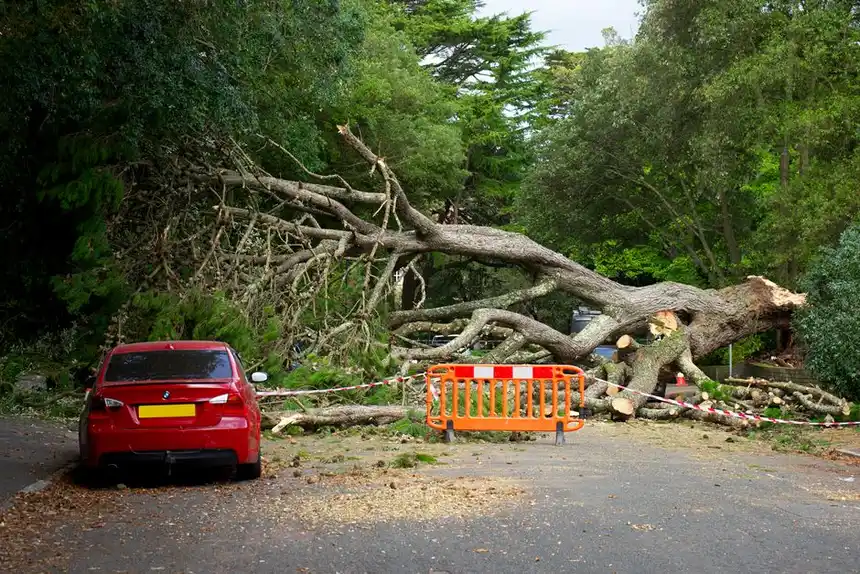
To safely remove storm-damaged tree limbs in Sandston, first confirm the limb is not resting on a power line or a structure, then cut from the branch tip back toward the trunk in small sections, and never stand under the limb you are cutting. If the limb is above your head, touching a wire, or larger than 6 inches in diameter, stop and call a professional. The rest of this guide covers how we assess storm-damaged trees in Henrico, the cutting order that actually works, what 2026 pricing looks like, and how to handle the insurance side.
Why storm-damaged tree limbs in Sandston are more dangerous than they look
A limb that survived the storm is not the same as a limb that is safe. Sandston sits on a mix of sandy loam and heavy clay, and that soil holds water differently after a nor'easter than it does after a summer thunderstorm. A 40-foot oak that looks upright can have a root plate that has already shifted 2 to 3 inches underground.
Three failure patterns show up on almost every storm tree removal Sandston job we run:
- Hangers. Limbs that broke but did not fall. They are held by bark or a splintered hinge and can drop with a 10 mph gust.
- Barber chairs. A split trunk where the two halves pinch a saw blade. The wood closes on the bar and traps it - or throws the saw.
- Spring poles. A bent sapling or limb under tension that releases 200 to 400 pounds of stored energy the moment you cut it.
If you see any of those three, that is your signal to back away and call someone with a bucket truck and rigging gear.
How do I safely remove storm-damaged tree limbs in Sandston?
You remove a storm-damaged limb safely by working in a fixed order: clear the drop zone, cut the small branches off the limb first, then section the main limb from the tip back to the trunk. Skipping the tip-first step is how most homeowner injuries happen.
Here is the sequence our crews use on every safe tree limb removal Sandston call:
- Set a 1.5x drop zone. If the limb is 20 feet long, keep everyone 30 feet back. That is the distance a limb of that length can bounce or roll.
- Look up, then look down. Check for wires, gutters, and the fence line. Then check the ground for the saw's path if the limb shifts.
- Cut the branch tips first. Take 3- to 4-foot sections off the outer end. Each cut removes weight and reduces the leverage on the hinge.
- Under-cut, then top-cut the main limb. A 1-inch under-cut prevents the bark from tearing down the trunk when the limb drops.
- Leave a 6- to 12-inch stub on the trunk. Cutting flush damages the branch collar and invites rot. The stub is not lazy - it is correct arboriculture.
- Clear the debris as you go. Do not let cut sections pile up under the tree. Tripping on a limb while holding a running saw is the most common injury on these jobs.
If the limb is on the ground and under 4 inches in diameter, this is a two-hour job with a pole saw and a hand saw. If it is hung up in the canopy, the math changes fast.
The equipment you actually need for tree limb removal after storm Sandston
For ground-level limbs under 4 inches, you need four things: a sharp hand saw or pole saw, loppers, work gloves, and safety glasses. That is it. A chainsaw is faster but adds a level of risk most homeowners do not need on a limb that is already down.
For anything overhead or over 6 inches, the list changes. You need a chainsaw with a 16- to 20-inch bar, a rope and rigging line rated to at least 5,000 pounds, a throw bag, a hard hat, and chaps. If you do not own chaps, do not run the saw. Chainsaw cuts to the thigh are the number one ER injury on storm cleanup weekends in Henrico.
One more piece of gear that gets skipped: a second person. Never cut a storm-damaged limb alone. If the limb pins you, there is no one to call 911.
Common mistakes we see on Sandston tree limb cleanup jobs
The mistakes are consistent. After a storm, we get called to finish jobs that started with a homeowner and a chainsaw, and the pattern is always the same.
- Cutting the trunk side first. This pinches the saw and drops the whole limb on the cutter.
- Standing on the downhill side. Limbs roll. They almost always roll downhill, and Sandston has plenty of sloped lots near the Chickahominy.
- Pulling a hung limb with a truck. This is how people rip gutters off, crack foundations, and snap the limb back into the cab.
- Cutting a limb that is touching a wire. Even a